
Guidance for Newly Qualified Lipspeakers
If you have recently completed an approved course and qualified as a Lipspeaker, this guidance sets out how you are supported during your first two years of registered practice, and what is expected of you as you build your professional experience.
Newly Qualified Lipspeakers are fully qualified, registered professionals. Unlike Regulated Trainees, you are not subject to formal practice restrictions or a Practice Assessor sign-off process. Instead, this guidance focuses on your continued relationship with a Senior Practitioner and on your own professional judgement in accepting assignments that are appropriate to your current skills and experience.
The Supportive Role of the Senior Practitioner
As a Newly Qualified Lipspeaker, you are at an early stage of your professional career. Although you have met the qualifying standard required for registration, your experience across the full range of assignments, settings and contexts you may encounter is still developing.
To support this ongoing development, you will continue to have contact with a Senior Practitioner during your first period of registration. This relationship is intended to help you consolidate your skills, build confidence, and reflect on your practice as you gain experience, in the same supportive spirit as the mentoring provided to Regulated Trainees.
Unlike the Regulated Trainee pathway, there is no separate Practice Assessor role for Newly Qualified Lipspeakers, and no requirement to submit formal practice assessments. Your registration is not conditional on assessment sign-off. The Senior Practitioner relationship for Newly Qualified Lipspeakers is developmental and advisory rather than assessed.
Senior Practitioner
Senior Practitioners will be required to have:
- 2 years+ experience as a Registered Language Service Professional
- Registration with NRCPD
- Knowledge and experience of providing mentoring services
Your Senior Practitioner will be a qualified and experienced Language Service professional, registered with NRCPD, who is able to support and scaffold your continued development. The purpose of this role is to provide advice and guidance on how you can best build your competence and confidence in a safe way, as you gain experience as a newly registered Lipspeaker.
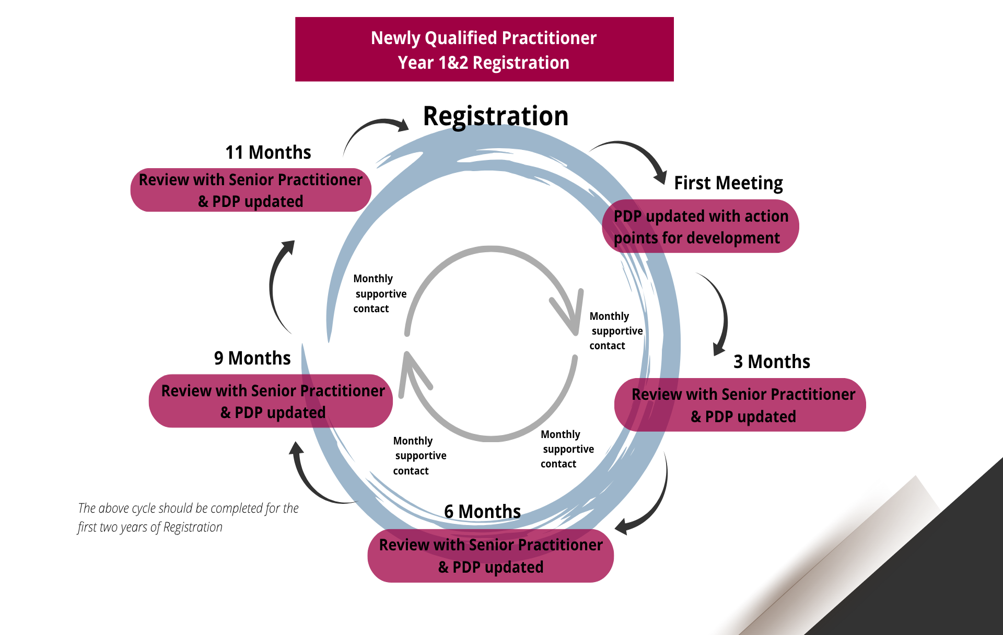
You should maintain regular contact with your Senior Practitioner, in the same way as during your training, through face-to-face or online meetings (one-to-one or in groups), and via email or other digital contact as appropriate.
Newly Qualified Lipspeaker – Registration Cycle
On qualifying and registering with NRCPD, you will be a Newly Qualified Practitioner
During this period you:
Accepting Assignments: Guidance, not Restriction
As a Newly Qualified Lipspeaker, you are not subject to the formal practice restrictions that apply to Regulated Trainees. You are a fully qualified, registered professional and are entitled to use your own professional judgement in deciding which assignments to accept.
With this professional autonomy comes personal responsibility. Rather than a fixed list of settings you must avoid, you are expected to actively and honestly assess every assignment offer against your own training, skills and experience before accepting it. In practice, this means you should:
- Only accept assignments that fall within the scope of what your training and experience to date have prepared you for.
- Be particularly cautious when considering assignments in high-stakes or unfamiliar settings — for example legal, complex health, mental health, or safeguarding and social care contexts — where you have limited direct experience, and take extra care to prepare thoroughly or seek support before accepting.
- Be honest with yourself, and with clients and agencies, about the limits of your current experience. It is better to decline, or to accept jointly with a more experienced colleague, than to take on an assignment that is beyond your current competence.
- Engage with your Senior Practitioner whenever you have any doubts about your own competence or readiness to accept a specific assignment. Your Senior Practitioner is there to help you think through unfamiliar or challenging assignment requests before you commit to them.
- Withdraw from an assignment, professionally and with appropriate notice, if it becomes clear once underway that it is beyond your competence, and discuss this with your Senior Practitioner afterwards.
- Keep a record of the types of assignments you undertake, so that you and your Senior Practitioner can track your growing experience over time and identify any areas where further development or support would be helpful.
If you are ever unsure whether you should accept an assignment, the safest course of action is to pause and consult your Senior Practitioner before responding to the client or agency.
Undertaking Remote Assignments
Remote assignments refer to assignments where you are at a separate location to other participants and are providing support via digital technology.
For the purpose of this guidance, and in line with best practice guidance from professional associations, Newly Qualified Lipspeakers should ensure that remote assignments:
- Fall within the scope of your current skills, training and experience, as set out above.
- Are undertaken in an environment that you have assessed to be safe and that protects your health and safety.
- Are ones for which you are familiar with the platform being used and have the required equipment.
In all remote assignments, you should ensure you have the necessary competency to work in a manner appropriate to the technology being used, and should discuss any concerns about remote or emergency-provision work with your Senior Practitioner.
Frequently Asked Questions
Do I still need a Practice Assessor once I am a Newly Qualified Lipspeaker?
No. The Practice Assessor role, and the requirement for formal practice assessments, applied to your time as a Regulated Trainee. As a Newly Qualified Lipspeaker you are fully registered and do not need Practice Assessor sign-off to continue practising.
Do I still need to work with a Senior Practitioner?
Yes. Continued contact with a Senior Practitioner is an important part of your ongoing development as a Newly Qualified Lipspeaker, even though this contact is now developmental rather than assessed.
Can my course tutor also be my Senior Practitioner?
Yes. However, you can choose to have a separate Senior Practitioner if you prefer.
Do I need to provide evidence of my Senior Practitioner review meetings?
Yes. NRCPD asks for the dates of your review meetings and confirmation that they have taken place. Your Senior Practitioner will confirm the details on their Senior Practitioners Portal.
Are there assignments I am not allowed to accept as a Newly Qualified Lipspeaker?
There is no fixed list of restricted settings for Newly Qualified Lipspeakers. Instead, you are expected to use your professional judgement, informed by your training and experience, and to consult your Senior Practitioner whenever you are unsure whether a particular assignment is right for you at your current stage of development.
Where can I get more information?
For further information, please email enquiries@nrcpd.org.uk